
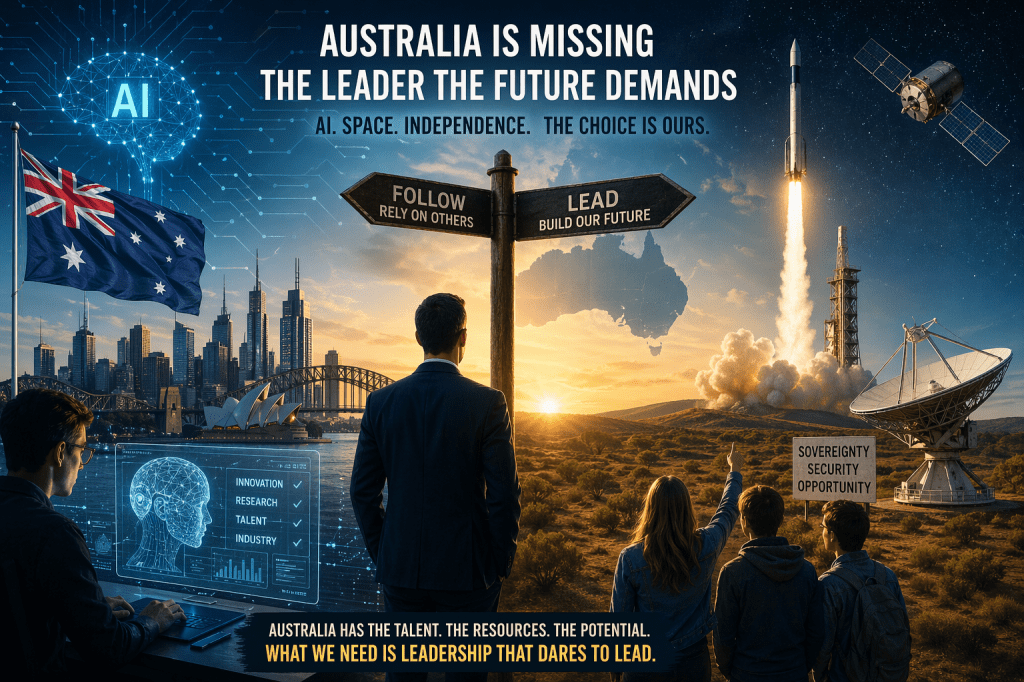
There is a particular kind of confidence that comes from knowing you are good enough. Australia has always had that. Stable economy, world-class universities, a functioning democracy, and a long track record of punching above its weight on the world stage. For most of the country’s modern history, that has been enough But the world is not waiting anymore.
Artificial intelligence and space technology are no longer science fiction. They are the foundations of the next global order. Who builds them, who controls them, and who writes the rules around them will decide which countries lead and which ones are left scrambling to keep up. Right now, Australia is watching from the sideline. That is not entirely the country’s fault. Australia has always favoured steady hands over bold ambitions. From Menzies to Hawke, the political tradition here has been one of gradual reform, building consensus, and solving problems . It works beautifully in normal times. But we are not living through normal times.
The AI Gap
Australia is not asleep on AI. Late in 2025, the federal government released its National AI Plan, covering safe adoption, skills development, and local capability. A National AI Safety Institute was announced. Chief AI Officers are being embedded across federal agencies.
But a plan is not leadership.
Australian business leaders have ranked AI as their single biggest concern , a first in KPMG Australia’s annual survey history. The private sector clearly feels the urgency. The question is whether the political class does too. Sensible goals do not build industries. They do not stop talented researchers from being poached by the United States, Canada, and the United Kingdom. What is missing is not more policy it is direction. A leader who will say, without hedging, that Australia will be a builder of transformative technology, not just a consumer of it.
- 63% say new technologies the number one concern for 2026
- 61% say new technologies the number one concern for the next 3-5 years
- 59% say the impact of new technologies is their number one social concern, out-ranking housing affordability
The Space Opportunity Australia Keeps Almost Taking
In July 2025, Gilmour Space Technologies attempted the first ever launch of an Australian built rocket from Australian soil at its Bowen Orbital Spaceport in North Queensland. By January 2026, the company had secured USD 145 million in fresh investment. A new deep space antenna was inaugurated in Western Australia. Agreements were signed with NASA, the European Space Agency, and the Korean Aerospace Administration. Katherine Bennell-Pegg became Australia’s first fully qualified astronaut under the Australian flag . The Australian Space Agency is largely set up to support international missions, not lead its own. The original goal of growing the domestic sector to 12 dollars and 20,000 new jobs by 2030 was set when the agency opened in 2020. Progress has been real, but the pace has not matched the ambition.
The momentum is real. But Australia still does not have a space program in the way India, China, or several European nations do. The agency is largely oriented around supporting international missions, not leading its own. The global space economy is heading toward one trillion dollars by 2040. The number of active satellites could grow from twelve thousand today to forty thousand by 2035. Space now drives communications, defence, intelligence, and economic leverage. Australia has the land, geography, alliances, and talent to be part of that story.
What Again it lacks is a leader willing to make that case loudly and consistently.
What Visionary Leadership Actually Looks Like Here
Australia does not need to become the next Silicon Valley. It does not need to pour hundreds of billions into a state run space program modelled on China’s approach.Those systems reflect very different political and economic conditions. What Australia actually needs is a clear, practical direction suited to its own strengths. A genuine leader would focus on building strong local industries, keeping skilled engineers and researchers in the country, and creating an environment where innovation can grow rather than leave. On artificial intelligence, Australia is well placed to become a regional leader in responsible and ethical AI use. It already has respected research institutions and a reputation for practical, evidence-based regulation. Unlike more aggressive models seen elsewhere, Australia can show that innovation and democratic accountability can work together But this potential only matters if there is leadership willing to turn it into a national strategy rather than isolated policy ideas.
Australia’s Tradition of Bold Leadership: From Whitlam to Fraser
Australia has actually had leaders who showed this kind of independent, forward-thinking approach before. It is not new to its political history. Malcolm Fraser consistently argued after his time in office that Australia had become too dependent on major powers like the United States and the United Kingdom. His view was not anti-alliance, but pro-independence—he believed Australia needed to think more strategically for itself and build stronger relationships within its own region.
Gough Whitlam also demonstrated what bold leadership looks like in practice. His government made major decisions that reshaped Australia’s direction, including recognising China early and introducing reforms that changed the country’s social and political identity. These were not cautious or incremental moves, but decisive actions driven by a clear sense of national direction.
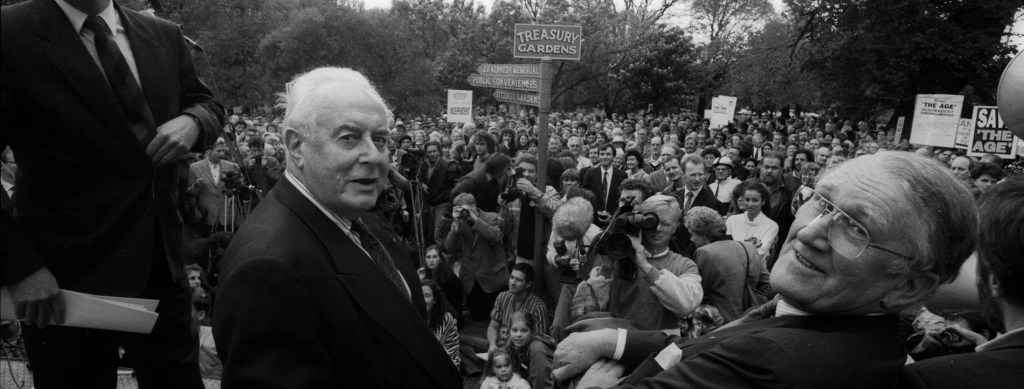
In 1991, former PMs Whitlam and Fraser were photographed at a rally in support of the free media and the Age newspaper, making waves as they did so. The two men found much in common after the unpleasantness of the 1975 dismissal, an event they never discussed. Credit: Fairfax Media
Fraser’s broader warning remains relevant today: Australia risks becoming strategically irrelevant in Asia if it continues to rely too heavily on external guidance rather than developing its own long-term thinking. The core lesson from both leaders is that Australia’s strength has always come from independent judgement and clear vision—not from waiting for other countries to set the agenda.
The Cost of Standing Still
If nothing changes, the consequences will not be dramatic. Australia will not collapse. It will stay prosperous and stable. But its influence will quietly erode. It will grow more dependent on other countries for the technologies that run its hospitals, power its cities, manage its borders, and connect its people. Its best technical minds will keep leaving. Its voice in shaping global technology standards will shrink. In the Indo-Pacific, where the competition between the United States and China is playing out across every domain including AI and space, middle powers that bring nothing concrete to the table will increasingly find themselves on the receiving end of other people’s decisions. Australia has AUKUS. It has the APEC (Asia-Pacific Economic Cooperation) It has Pacific Islands Forum(PIF) and it has QUAD Too. It has a genuine stake in how this region takes shape. But alliances are only as strong as what each party actually brings to them. When it comes to technology leadership, Australia is largely benefiting from the work of others rather than contributing meaningfully to it.
The Leader Australia Needs
The talent exists. The research exists too. Australia has world class universities, a growing startup ecosystem, and geographic advantages for space activity that most countries would genuinely wish. The raw ingredients are sitting there. What is missing is a leader willing to articulate a national technological vision and pursue it with real conviction not as a paragraph buried in a policy document, but as a genuine national mission.
The kind of leader who understands that building sovereign capability in artificial intelligence and space is not only an economic question. It is a question of strategic independence. Of national identity. Of whether Australia enters the next century as someone who helped shape the world or someone who simply watched it unfold. Australia has always been good at surviving. The question now is whether it is ready to lead.
References
- KPMG Australia — AI Biggest Concern for Australian Business Leaders in 2026 and Beyond — kpmg.com/au
- MinterEllison — Australia Introduces a National AI Plan: Four Things Leaders Need to Know — minterellison.com
- DLA Piper — Australia’s Growing Space Industry: Key Developments — dlapiper.com (February 2026)
- Australian Space Agency — International Partnerships space.gov.au
- Australian Space Agency — 2025 Year in Review — space.gov.au.
- Australian Space Agency — Wikipedia entry — en.wikipedia.org/wiki/Australian_Space_Agency
- https://spacecentreaustralia.com/wp-content/uploads/2025/05/AUS-SPACE-2025.pdf

Leave a comment